Meanwhile at the Poetry Reading

Explaining the Poem


This first began percolating on the day I came across the corpse of a bird that flew into my sliding glass door, his head twisted like the bottom of a semi-colon, his wings brackets around the parenthetical body; of course it immediately drew recollections of Amelia Earhart, Kitty Hawk and the story of Daedalus and Icarus.  Interestingly enough, I had recently spilled melted wax near the spot where the bird lay, a souvenir or stain of a certain physical interlude involving, yes, candles, handcuffs and two…  Picking up the bird gave way to the Karate Kid movies, though I don’t really consider the third because it seemed so out of place.  The 80s reference is for me, and should be for the reader, a call to a simpler time in American cinema where stories were told, events shown and a special effect was added to drive a point home or try something new.  It is also a salute to The Tao of Pooh and The Te of Piglet with which I have identified and immersed myself in my surfing on the net late at night, a cup of decaf in one hand, cordless mouse in the other.  As you can imagine the glories of 21st Century technology are dominant in the poem, foremost because it is typed.  The final line is a surrender, a sort of poetic salute to those who have braved death in the hopes of furthering some cause.  The final line is also a reference to the letter Ω which indeed means end, but can also be argued to be a representation of a U-turn thus turning the reader around to begin the poem again, a new journey with a new experience and perhaps, hopefully, a new end.

The Poem

freedom buzzing incessantly around my head,
a Zen moment, trapped in chopsticks
then clipped wings
on the table shuddering.  I recalled singing in a
musical called
Don’t You Wanna Be Free?
I nodded in unison with the seizing abstraction below me

National Poetry Month is here! Let’s celebrate with, well, a few poems.

In honor of NPM (not to be confused with NPH), every few days I’ll be posting a poem to the blog. Look for some things old, some things new, no things borrowed and maybe, just maybe, something purple.  I invite questions, comments, dialogue; let’s talk of poetry.

For our inaugural installment, I offer

First Words


I will wake quietly, only a hmmph to red-hued digits;
I will read aloud books, worderfalls flooding from tongue;
I will greet strangers and friends, poke fun at politicians and passers-by;
I will rise early to greet the sun, and join her as she puts herself to bed;
I will make phone calls and write letters, being careful to scratch out mistakes just so;
I will travel, getting lost in blank white spaces;
I will have cancellations, and be late due to my travels;
I will set giraffes on fire, a low flame that only barely begs attention;
I will drip water from my fingertips, and catch the drops in coffee cups;
I will drive late, jazz wafting from speakers, slow lolling French echoing in my ears;
I will beat the drum different, confusing marchers;
I will hope for mermaids with fish-heads and peach-flesh ripe for eating;
I will drink red wine and have my head spin burgundy thoughts;
I will make appointments, and arrive dressed in upside-down fedoras and corduroy pants;
I will scribble dribble and fall in love, not necessarily in that order;

I will ride zebras, sing incomprehensibly, walk rapidly and wear boxers; I will laugh out loud at
jokes in my head; I will cry when I read novels and see commercials;

I will have brief moments of silence,

and you will not know.

The Loss of Literary Giant, The Power of Art

Two events of late seemed to converge in my mind, making this big, blue marble seem more like a little, blue marble in my hand.

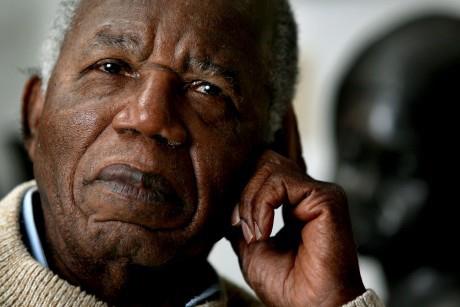
achebeThe first is the passing of a literary giant, Chinua Achebe, whose “Things Fall Apart” you should have already read already. If not, get thee to your local bookery, um, bookstall, er, bookmonger, or big-box book shop. (Let me interject to say that I’m very disappointed we don’t have more synonyms for bookstore, nothing with a ring to it like bouquiniste in French. But I digress, though I vow to use bookmonger more often.)

With the loss of this man, often called the “Father of African Literature,” I’ve given much thought to my own  invitation to African letters.  I must admit, I came to  Achebe much later in my literary addiction. My gateway was the French-speaking countries of North and West Africa and the Caribbean; my hosts included Léopold Senghor, Camara Laye and, even earlier, Aimé Césaire.  Since then, I’ve read the likes of Tchicaya U Tam’si, Kateb Yacine, Ahmadou Kourouma, Mariama Bâ, Patrick Chamoiseau,Werewere Liking, Assia Djebar—the list goes on.  I’ve used Césaire in poetry workshops, I’ve heard Wole Soyinka speak, I’ve shared margaritas with Alain Mabanckou.

I know it is a cliché to say that reading opens up the world to you, but there is truth in it.  And the world must be opened.  If we are ever to get along, or help each other, we must understand each other.  As Ferlinghetti declared, the world is a beautiful place to be born into. But it’s so much more, it’s big and its beauty is never-ending, we simply need to look for it.

Chinua Achebe captured this succinctly when he said:

“I believe in the complexity of the human story and that there’s no way you can tell that story in one way and say, This is it. Always there will be someone who can tell it differently depending on where they are standing; the same person telling the story will tell it differently. I think of that masquerade in Igbo festivals that dances in the public arena. The Igbo people say, If you want to see it well, you must not stand in one place. The masquerade is moving through this big arena. Dancing. If you’re rooted to a spot, you miss a lot of the grace. So you keep moving, and this is the way I think the world’s stories should be told—from many different perspectives.”

I am grateful for the perspective of Chinua Achebe.

*****

The second was my latest trip to the Menil Collection in Houston, Texas to view the recently-closed exhibition “The Progress of Love.” Rather than try to sum it up, here’s a summary from the official site:

“The Progress of Love is an unprecedented, transatlantic collaboration between the Menil Collection in Houston; the Centre for Contemporary Art in Lagos, Nigeria; and the Pulitzer Foundation for the Arts in St. Louis that explores the universal emotion of love. The three concurrent but unique exhibitions that make up The Progress of Love constitute a narrative arc, addressing love as an ideal, love as a lived experience, and love as something lost.

The Progress of Love at the Menil presents works by more than 20 artists from Africa, Europe, and America and examines the ways in which language, mass media, cultural traditions, and socioeconomic forces foster images and expectations about love. The exhibition pays particular attention to the effects of the digital era, asking whether our ideas about love are now coming into closer alignment across the Atlantic.”

Saddened though I am that I am unable to head to St. Louis and Lagos to experience all three exhibitions, I was enthralled by the offering at the Menil.  Rich, moving, smart, my only disappointment was that I couldn’t stay longer.

Much of my time was eaten up by the installation piece of Romuald Hazoumè, from which I had much difficulty in pulling myself away.  So enamored was I that I wrote an ekphrastic poem inspired by the work; it is a tribute to the NGO SBOP—Solidarité Béninoise pour Occidentaux en Péril (Beninese Solidarity with Endangered Westerners)—featured in the piece.   According to the pamphlet available in the installation, “SBOP wants to reverse the trend: the citizens of under-developed countries could also help those of developed countries…and also help themselves.”

 The Progress of Love

As you can see in the photo, the installation is quite complex:  at the back, a wall; on the left, a TV showing documentary footage of the fundraising efforts by various Beninese celebrities; on the right, a TV showing still images of all the community agencies offering aid to people in Cotonou, Benin. In the center, a “closet” entered through a “bead” curtain (made from folded beer bottle caps) in which copies of clippings from articles about the NGO in French and African newspapers are mounted. In front of the wall, chairs, a table, and a desk made from used five-gallon oil/gas containers (a common theme in the work of Hazoumè).

The film follows Zeynab, Eléphant Mouillé, Danialou Sagbohan, John Arcadius, and Angélique Kidjo (the aforementioned celebrities) as they stroll through market and street, asking for contributions to the NGO. The residents of Cotonou are dubious, the plight of the white westerner difficult to fathom. But SBOP is convincing, and slowly but surely under-developed countries help the developed.  The gesture is unmistakable, the assistance real.

The poem (which you can find here) comes from this footage as well as the comment that has appeared of late in American social media, in which people complain about first-world problems (my cell/wi-fi doesn’t work, the bus was late, my A/C is out, etc).  These complaints contrast sharply with the willful ignorance of the problems we do have.   It is an early draft, far from complete, but its timing seems appropriate.

*****

I write this because my perspective on the world has been influenced by the work of Chinua Achebe.  I write this because, through literature, I have found a voice in which I may offer my own perspective.  I write this because, through the stories and histories of Africa, my shelves and mind are ever-expanding and continually understanding.  I write this because of the travels, real and imagined, inspired by the writings of Achebe and Senghor and others; because of the friends to whom their art has guided me.

Pick up a copy of “Things Fall Apart.”  Spend some time reading about “The Progress of Love.”  Take a journey that is no more out of reach than your bookshelf and your internet browser.

This is for Sani and Lamaka.

In memoriam, Chinua Achebe.
First World Problems — An Early Draft

First World Problems

                                    pour Sani, pour Lamaka
pour ONG SBOP


 jingling in the gallon, scrunching of bills, flip in front of flop through the market and down the street–steps of valiant members of NGO SBOP—Solidarité Béninoise pour Occidentaux en Péril—Beninese Solidarity with Endangered Westerners—who call to action and reaction

“Can you give today? Spare some coins, share some bills! They need help in the West, the Whites in the West!”

occidentals accidentally wandering the streets, eyephone statue of libertied in search of 4G and free wi-fi. help for the whites, poor, poor whites, with fat non-flat TVs and regular ray DVDs

“Help for the whites, help for the West! —help the poor in America, the hungry. Not everyone is rich like J.R. Ewing! Aid for the white poor!”

westerners wasting away—poor? poor literacy perhaps, poor manners, poor attitudes and poor gratitudes, poor pub men pouring piss-poor PBRs in pilsners, poor wages and poor vision, poor women and war rages, poor insurance, health, independence, poor wealth

occidentals enduring accidents

“They are hungry in America, they suffer drought and hurricanes, they have no homes, they have no help!”

“Well then, brother—
“Well then, sister—
how can we help?”

“Share your change, even a little will help. We may have here next to nothing, but we can help. We know how to help,

                                                              We in Africa have love, love for our neighbors.
                                                                           But in their country, they have no love,
                                                              no love for helping their neighbors.

I did not know this.”

“And so you know, and you must help our poor, Western brothers and sisters, endangered and angered, imperiled and impoverished. We must show them the love for neighbor in Benin, our neighbors on the globe…”

change for a chance , and then more jingle into the gallon

et aussi
pour Zeynab,
pour Eléphant Mouillé,
pour Danialou Sagbohan,
pour John Arcadius,
pour Angélique Kidjo

For a brief word about the origins and inspiration of this poem, simply click here.

It’s got a funky beat, and I can really picket to it!

We all know about the ineffable quality of art—we can’t always explain why New Edition’s “Can You Stand the Rain” makes us feel better after a break-up, why CarlyRae Jepsen’s “Call Me Maybe” makes us want to film parody videos, or why we stand immersed, overwhelmed by Monet’s “Water Lilies.” But the artists, they know what they’re doing—Jean-Paul Rappeneau is fully aware that pulling the camera up and away, through the trees, as “Cyrano de Bergerac” dies, will leave us with a pit in our stomach; Mel Brooks recognizes that his “Blazing Saddles” campfire scene will leave you laughing no matter how often you see it.

Every creator, from the painter to the director to the composer, wants to evoke something. Through pop stars and film noir cinéastes and the Surrealists, art has the power to provoke joy, fear, anger. Even action.

Yes, protest music.  Everyone should have their favorite artist or genre, and few genres protest better than hip hop.  It has made the likes of Public Enemy and Paris icons for their peers. And in France, the engagement of hip hop has moved to a completely different level.  IAM, Kéry James, Assassin, Saïan Supa Crew, Disiz la Peste. They all have something to tell you.

Today’s translation comes from France’s Le Monde newspaper, a short blog post from about two weeks ago. The subject: an employee in a soon-to-be closed automobile plant not far from Paris. It just so happens that this assembly line worker is also an emcee in the group Tango & Kash, who have one album to their name.  The power of art can voice your anger, and in this case, hip hop is that voice, the way for the plant workers at Aulnay to speak in their own defense.

Please, read the translation of the blog, then watch the music video. Even if you don’t understand all the lyrics, the images are powerful in themselves. At the very end, for those who speak French, you’ll find a short documentary-style clip where the emcee Kash is interviewed, then gives us a little a cappella excerpt of the song.

Here is the link to the original post at Le Monde.

Please enjoy.

*****

“Of course there’s anger when they talk about restructuring,
Smoke screen as dangerous as exhaust gas.
False hopes reduced to nothing,
in the rhythm of their pretty, feel-guilty speeches.”

 Putting faces and words on the anger felt by 3000 employees at the Aulnay-sous-Bois plant run by PSA Peugeot Citroën. That was the object of Franck Jautee, stage name Kash. When he’s not running a team of six workers on the assembly line of the plant, Franck Jautee runs raps with his group, Tango and Kash.  On July 12, when PSA announced the closing of the plant at Aulnay, his colleagues asked him to write a song, so tells us the blog Aulnay Stories, of France Télévisions, which chronicles the daily struggle of the workers of the plant.  “I said, ‘Okay, I’ll make the music, but at the end of the summer, you all have to be in the video.” A few months later, on January 30, with the help of two other hip hop and video devotees, Sébastien and Régis, the clip was posted on the Internet. The buzz built quickly: in a few days, the video “ Ça peut plus durer ” was seen by close to 20,000 viewers.

“Verbal hold-up, a liar since the beginning,
our boss has more vices than the dealers in our streets.”

The rap mixes the crafted texts of Franck Jautee with news reports on the announced closing of the plant. You can hear in them the voice of David Pujadas, the newscaster of France 2’s evening broadcast. You can also hear one of his questions: “How far are you willing to go? — We’ll stop at nothing, go all the way to the end.”  The camera shifts between the assembly lines, showing workers at their jobs, and at their picket lines. “Sadness, anger, worry, sacrifice, depression, discontent, it can’t go on any longer…” The 35-year-old rapper has a good feel for a turn-of-phrase. Under his pen, PSA becomes “Politics in the Service of the Shareholder” [“Politiques au Service d’Actionnaires”] and “Bosses Sabotaging the Future” [“Patrons Saboteurs d’Avenir”].

Fifty-five employees let themselves be filmed for the needs of the video, according to Aulnay Stories. “I had to show who the people of PSA are, those who are going to find themselves either on the streets or part of some iffy layoff schemes, hidden behind smoke screens,” Franck Jautee explains to the journalists of France Télévisions, “They are the ones who will suffer all of that, they’re the ones who hurt.”  The musician, a worker on strike, envisions his video as a tool in the hands of the workers of Aulnay. On the Youtube page of the clip, a union rep from Créteil asks permission to download the video to share.  “Be my guest, enjoy yourself” Kash tells him.


Here is some documentary-style footage from Francine Raymond & Ludovic Fossard, authors of the blog Aulnay Stories :

*****