Another NPM installment!

Making the Love Scene


you slamming the door is
(…a beautiful place to be born into
 
if you don’t mind some people dying all the time…)*
a smack of arrival.  I hear

squeak of Nike on linoleum, accented
by the rain outside.

it’s hard to pull myself off the couch
my butt lazily glued there during the

rainy day.  I do, to glue
my lips on your face before you

set down your bags.  Close your eyes
while my tongue dances on your

tongue, your lips.  My eyes close because
(Oh the world is a beautiful place to be born into
 
if you don’t much mind a few dead minds in the higher places)
your feel is a memory of my taste.

(Pictures of the Gone World can wait;
but then right in the middle of it comes the smiling mortician.)

And open—

Your skin smells of peppermint (that’s odd)
I never knew your tongue to be so sharp, nor your lips
to be so
                open.  Your mouth
     seems hollow.  Your eyes don’t follow mine
                                           as they dance from the nape of your neck
                                to your breast.

No bra?  Your nipples erect, a deep brown I
don’t know.  Your neck tastes like
candy.  Take hold of my hand
to the places I should know.

                                         I feel your left breast for the first time
                                         the white wet shirt a tease
                       I don’t know this panting
                       the heave that matches the pinch.
                                       Your hair breathes Herbal Essences, I thought
                                                    you used Pantene.

What happened to the cinnamon
that used to dance on your exhale?
The honey that used to drip from
your thighs?
                                                It’s all peppermint and crème,
                   it’s all liqueur and chocolate.  I don’t remember
                                              the join of your legs.  Wasn’t it
                               smoother?  Take
       my hand.  Do you know it?
Put it where I can remember.
Not between your legs, or at the sweat that
                                tingles between your breasts,
                                          but at the curve of your ear
                                                         or the slope of your navel,
                                                                take my hands
teach me.

I’ve never known you.

*all quotes, L. Ferlinghetti

Meanwhile at the Poetry Reading

Explaining the Poem


This first began percolating on the day I came across the corpse of a bird that flew into my sliding glass door, his head twisted like the bottom of a semi-colon, his wings brackets around the parenthetical body; of course it immediately drew recollections of Amelia Earhart, Kitty Hawk and the story of Daedalus and Icarus.  Interestingly enough, I had recently spilled melted wax near the spot where the bird lay, a souvenir or stain of a certain physical interlude involving, yes, candles, handcuffs and two…  Picking up the bird gave way to the Karate Kid movies, though I don’t really consider the third because it seemed so out of place.  The 80s reference is for me, and should be for the reader, a call to a simpler time in American cinema where stories were told, events shown and a special effect was added to drive a point home or try something new.  It is also a salute to The Tao of Pooh and The Te of Piglet with which I have identified and immersed myself in my surfing on the net late at night, a cup of decaf in one hand, cordless mouse in the other.  As you can imagine the glories of 21st Century technology are dominant in the poem, foremost because it is typed.  The final line is a surrender, a sort of poetic salute to those who have braved death in the hopes of furthering some cause.  The final line is also a reference to the letter Ω which indeed means end, but can also be argued to be a representation of a U-turn thus turning the reader around to begin the poem again, a new journey with a new experience and perhaps, hopefully, a new end.

The Poem

freedom buzzing incessantly around my head,
a Zen moment, trapped in chopsticks
then clipped wings
on the table shuddering.  I recalled singing in a
musical called
Don’t You Wanna Be Free?
I nodded in unison with the seizing abstraction below me

National Poetry Month is here! Let’s celebrate with, well, a few poems.

In honor of NPM (not to be confused with NPH), every few days I’ll be posting a poem to the blog. Look for some things old, some things new, no things borrowed and maybe, just maybe, something purple.  I invite questions, comments, dialogue; let’s talk of poetry.

For our inaugural installment, I offer

First Words


I will wake quietly, only a hmmph to red-hued digits;
I will read aloud books, worderfalls flooding from tongue;
I will greet strangers and friends, poke fun at politicians and passers-by;
I will rise early to greet the sun, and join her as she puts herself to bed;
I will make phone calls and write letters, being careful to scratch out mistakes just so;
I will travel, getting lost in blank white spaces;
I will have cancellations, and be late due to my travels;
I will set giraffes on fire, a low flame that only barely begs attention;
I will drip water from my fingertips, and catch the drops in coffee cups;
I will drive late, jazz wafting from speakers, slow lolling French echoing in my ears;
I will beat the drum different, confusing marchers;
I will hope for mermaids with fish-heads and peach-flesh ripe for eating;
I will drink red wine and have my head spin burgundy thoughts;
I will make appointments, and arrive dressed in upside-down fedoras and corduroy pants;
I will scribble dribble and fall in love, not necessarily in that order;

I will ride zebras, sing incomprehensibly, walk rapidly and wear boxers; I will laugh out loud at
jokes in my head; I will cry when I read novels and see commercials;

I will have brief moments of silence,

and you will not know.

The Loss of Literary Giant, The Power of Art

Two events of late seemed to converge in my mind, making this big, blue marble seem more like a little, blue marble in my hand.

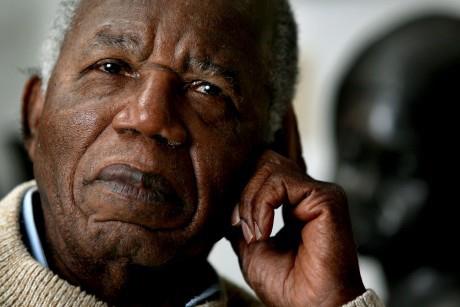
achebeThe first is the passing of a literary giant, Chinua Achebe, whose “Things Fall Apart” you should have already read already. If not, get thee to your local bookery, um, bookstall, er, bookmonger, or big-box book shop. (Let me interject to say that I’m very disappointed we don’t have more synonyms for bookstore, nothing with a ring to it like bouquiniste in French. But I digress, though I vow to use bookmonger more often.)

With the loss of this man, often called the “Father of African Literature,” I’ve given much thought to my own  invitation to African letters.  I must admit, I came to  Achebe much later in my literary addiction. My gateway was the French-speaking countries of North and West Africa and the Caribbean; my hosts included Léopold Senghor, Camara Laye and, even earlier, Aimé Césaire.  Since then, I’ve read the likes of Tchicaya U Tam’si, Kateb Yacine, Ahmadou Kourouma, Mariama Bâ, Patrick Chamoiseau,Werewere Liking, Assia Djebar—the list goes on.  I’ve used Césaire in poetry workshops, I’ve heard Wole Soyinka speak, I’ve shared margaritas with Alain Mabanckou.

I know it is a cliché to say that reading opens up the world to you, but there is truth in it.  And the world must be opened.  If we are ever to get along, or help each other, we must understand each other.  As Ferlinghetti declared, the world is a beautiful place to be born into. But it’s so much more, it’s big and its beauty is never-ending, we simply need to look for it.

Chinua Achebe captured this succinctly when he said:

“I believe in the complexity of the human story and that there’s no way you can tell that story in one way and say, This is it. Always there will be someone who can tell it differently depending on where they are standing; the same person telling the story will tell it differently. I think of that masquerade in Igbo festivals that dances in the public arena. The Igbo people say, If you want to see it well, you must not stand in one place. The masquerade is moving through this big arena. Dancing. If you’re rooted to a spot, you miss a lot of the grace. So you keep moving, and this is the way I think the world’s stories should be told—from many different perspectives.”

I am grateful for the perspective of Chinua Achebe.

*****

The second was my latest trip to the Menil Collection in Houston, Texas to view the recently-closed exhibition “The Progress of Love.” Rather than try to sum it up, here’s a summary from the official site:

“The Progress of Love is an unprecedented, transatlantic collaboration between the Menil Collection in Houston; the Centre for Contemporary Art in Lagos, Nigeria; and the Pulitzer Foundation for the Arts in St. Louis that explores the universal emotion of love. The three concurrent but unique exhibitions that make up The Progress of Love constitute a narrative arc, addressing love as an ideal, love as a lived experience, and love as something lost.

The Progress of Love at the Menil presents works by more than 20 artists from Africa, Europe, and America and examines the ways in which language, mass media, cultural traditions, and socioeconomic forces foster images and expectations about love. The exhibition pays particular attention to the effects of the digital era, asking whether our ideas about love are now coming into closer alignment across the Atlantic.”

Saddened though I am that I am unable to head to St. Louis and Lagos to experience all three exhibitions, I was enthralled by the offering at the Menil.  Rich, moving, smart, my only disappointment was that I couldn’t stay longer.

Much of my time was eaten up by the installation piece of Romuald Hazoumè, from which I had much difficulty in pulling myself away.  So enamored was I that I wrote an ekphrastic poem inspired by the work; it is a tribute to the NGO SBOP—Solidarité Béninoise pour Occidentaux en Péril (Beninese Solidarity with Endangered Westerners)—featured in the piece.   According to the pamphlet available in the installation, “SBOP wants to reverse the trend: the citizens of under-developed countries could also help those of developed countries…and also help themselves.”

 The Progress of Love

As you can see in the photo, the installation is quite complex:  at the back, a wall; on the left, a TV showing documentary footage of the fundraising efforts by various Beninese celebrities; on the right, a TV showing still images of all the community agencies offering aid to people in Cotonou, Benin. In the center, a “closet” entered through a “bead” curtain (made from folded beer bottle caps) in which copies of clippings from articles about the NGO in French and African newspapers are mounted. In front of the wall, chairs, a table, and a desk made from used five-gallon oil/gas containers (a common theme in the work of Hazoumè).

The film follows Zeynab, Eléphant Mouillé, Danialou Sagbohan, John Arcadius, and Angélique Kidjo (the aforementioned celebrities) as they stroll through market and street, asking for contributions to the NGO. The residents of Cotonou are dubious, the plight of the white westerner difficult to fathom. But SBOP is convincing, and slowly but surely under-developed countries help the developed.  The gesture is unmistakable, the assistance real.

The poem (which you can find here) comes from this footage as well as the comment that has appeared of late in American social media, in which people complain about first-world problems (my cell/wi-fi doesn’t work, the bus was late, my A/C is out, etc).  These complaints contrast sharply with the willful ignorance of the problems we do have.   It is an early draft, far from complete, but its timing seems appropriate.

*****

I write this because my perspective on the world has been influenced by the work of Chinua Achebe.  I write this because, through literature, I have found a voice in which I may offer my own perspective.  I write this because, through the stories and histories of Africa, my shelves and mind are ever-expanding and continually understanding.  I write this because of the travels, real and imagined, inspired by the writings of Achebe and Senghor and others; because of the friends to whom their art has guided me.

Pick up a copy of “Things Fall Apart.”  Spend some time reading about “The Progress of Love.”  Take a journey that is no more out of reach than your bookshelf and your internet browser.

This is for Sani and Lamaka.

In memoriam, Chinua Achebe.
First World Problems — An Early Draft

First World Problems

                                    pour Sani, pour Lamaka
pour ONG SBOP


 jingling in the gallon, scrunching of bills, flip in front of flop through the market and down the street–steps of valiant members of NGO SBOP—Solidarité Béninoise pour Occidentaux en Péril—Beninese Solidarity with Endangered Westerners—who call to action and reaction

“Can you give today? Spare some coins, share some bills! They need help in the West, the Whites in the West!”

occidentals accidentally wandering the streets, eyephone statue of libertied in search of 4G and free wi-fi. help for the whites, poor, poor whites, with fat non-flat TVs and regular ray DVDs

“Help for the whites, help for the West! —help the poor in America, the hungry. Not everyone is rich like J.R. Ewing! Aid for the white poor!”

westerners wasting away—poor? poor literacy perhaps, poor manners, poor attitudes and poor gratitudes, poor pub men pouring piss-poor PBRs in pilsners, poor wages and poor vision, poor women and war rages, poor insurance, health, independence, poor wealth

occidentals enduring accidents

“They are hungry in America, they suffer drought and hurricanes, they have no homes, they have no help!”

“Well then, brother—
“Well then, sister—
how can we help?”

“Share your change, even a little will help. We may have here next to nothing, but we can help. We know how to help,

                                                              We in Africa have love, love for our neighbors.
                                                                           But in their country, they have no love,
                                                              no love for helping their neighbors.

I did not know this.”

“And so you know, and you must help our poor, Western brothers and sisters, endangered and angered, imperiled and impoverished. We must show them the love for neighbor in Benin, our neighbors on the globe…”

change for a chance , and then more jingle into the gallon

et aussi
pour Zeynab,
pour Eléphant Mouillé,
pour Danialou Sagbohan,
pour John Arcadius,
pour Angélique Kidjo

For a brief word about the origins and inspiration of this poem, simply click here.

Un- Titled, in two parts

Un-

titled, in two parts


I.  Identity

crise always never knowing d’identité mirrors remain unhelpful crise photos only archival de conscience i’ve only ever known what i used to be, visions of what i will become crise what i am remains the (in)variable unknown d’identité reflection always foreign, a stranger—the ‘Hello my name is…’ forever blank;   i have at various times played the Black Widow Gambit, relying on who i was with Her and without;  and Her always either just leaving or just arriving; stay,  it seems, only applied to my execution  crise it is up for debate whether the scars make part of who i am or vice-versa d’identité  i’ve grown accustomed to not knowing my own name, moments where i do not respond to      … one time, after several drinks, i thought i met the man in the mirror—having passed out soon after, i forgot to ask his name   crise   i’ve carried around this cahier, grateful it’s never been lost (no one would know to whom it should be returned);  every word written with my right hand, but i can only tell you what the left looks like d’indentité  i remember very well what they both have caressed, including my own abandoned form;  no book i’ve ever owned has been inscribed; bills addressed to resident; despite regular prompt payments to the phone company, i’ve never heard it ring; it seems long ago i should have ceased posing the question, content with shadows, one-handed scribblings, unaddressed whispers, blank sheets, one hand, empty sheets… i’ve too often heard ‘Good bye.’  i’m holding out for just one ‘Good night ______’; just one.

II.  Obituary


The Greeks did not write obituaries; after a man died they only asked one question:
Did he have passion?
Dean to Jonathan in “Serendipity”


DS, sometime poet, sometime friend, died last night due to complications under as yet misunderstood circumstances.  At this time, it is only confirmed that he died by his own hand.   His final days are a mystery, though it seems that pieces of his life remain less so.  It is certain that he loved, evidenced by the scarring of three vaguely female forms etched just below the skin on the left side of his chest. The women of his life were always either just leaving or just arriving (why wouldn’t they stay?)—reflections in his eyes and nothing more.  His struggle was complicated by the fact that he defined himself by what he used to be or what he would become; his inability to ever know who he was proved debilitating.                                           .   He was found with an un-dog-eared copy of Endless Life, a small black cahier and a fountain pen, from which the ink  would fall onto paper then leap onto loose lips, and  from loose lips, ink spatter, sprayed as much as said, would fall onto deaf ears and into mute eyes; we can say with confidence that too few understood.   His teeth were stained Bordeaux, he smelled of sage flower and vanilla.  Ink had shaded portions of his right hand and the tip of his left index finger.  His eyes were open. The room echoed with a sax and trumpet, a wine glass shatter.  Nearby, next to the drunken shards, a map, several roads marked “Too few, too few.”   He is survived by a few poems, some scattered, some tattered; by innumerous filled and dusty bookshelves; by the words bouleversant and authentic; by manuscripts long unopened.   Services have not yet been arranged, though it is thought that he only wanted one question to be asked by mourners, and if the answer should prove to be no, that he be buried without…

It’s got a funky beat, and I can really picket to it!

We all know about the ineffable quality of art—we can’t always explain why New Edition’s “Can You Stand the Rain” makes us feel better after a break-up, why CarlyRae Jepsen’s “Call Me Maybe” makes us want to film parody videos, or why we stand immersed, overwhelmed by Monet’s “Water Lilies.” But the artists, they know what they’re doing—Jean-Paul Rappeneau is fully aware that pulling the camera up and away, through the trees, as “Cyrano de Bergerac” dies, will leave us with a pit in our stomach; Mel Brooks recognizes that his “Blazing Saddles” campfire scene will leave you laughing no matter how often you see it.

Every creator, from the painter to the director to the composer, wants to evoke something. Through pop stars and film noir cinéastes and the Surrealists, art has the power to provoke joy, fear, anger. Even action.

Yes, protest music.  Everyone should have their favorite artist or genre, and few genres protest better than hip hop.  It has made the likes of Public Enemy and Paris icons for their peers. And in France, the engagement of hip hop has moved to a completely different level.  IAM, Kéry James, Assassin, Saïan Supa Crew, Disiz la Peste. They all have something to tell you.

Today’s translation comes from France’s Le Monde newspaper, a short blog post from about two weeks ago. The subject: an employee in a soon-to-be closed automobile plant not far from Paris. It just so happens that this assembly line worker is also an emcee in the group Tango & Kash, who have one album to their name.  The power of art can voice your anger, and in this case, hip hop is that voice, the way for the plant workers at Aulnay to speak in their own defense.

Please, read the translation of the blog, then watch the music video. Even if you don’t understand all the lyrics, the images are powerful in themselves. At the very end, for those who speak French, you’ll find a short documentary-style clip where the emcee Kash is interviewed, then gives us a little a cappella excerpt of the song.

Here is the link to the original post at Le Monde.

Please enjoy.

*****

“Of course there’s anger when they talk about restructuring,
Smoke screen as dangerous as exhaust gas.
False hopes reduced to nothing,
in the rhythm of their pretty, feel-guilty speeches.”

 Putting faces and words on the anger felt by 3000 employees at the Aulnay-sous-Bois plant run by PSA Peugeot Citroën. That was the object of Franck Jautee, stage name Kash. When he’s not running a team of six workers on the assembly line of the plant, Franck Jautee runs raps with his group, Tango and Kash.  On July 12, when PSA announced the closing of the plant at Aulnay, his colleagues asked him to write a song, so tells us the blog Aulnay Stories, of France Télévisions, which chronicles the daily struggle of the workers of the plant.  “I said, ‘Okay, I’ll make the music, but at the end of the summer, you all have to be in the video.” A few months later, on January 30, with the help of two other hip hop and video devotees, Sébastien and Régis, the clip was posted on the Internet. The buzz built quickly: in a few days, the video “ Ça peut plus durer ” was seen by close to 20,000 viewers.

“Verbal hold-up, a liar since the beginning,
our boss has more vices than the dealers in our streets.”

The rap mixes the crafted texts of Franck Jautee with news reports on the announced closing of the plant. You can hear in them the voice of David Pujadas, the newscaster of France 2’s evening broadcast. You can also hear one of his questions: “How far are you willing to go? — We’ll stop at nothing, go all the way to the end.”  The camera shifts between the assembly lines, showing workers at their jobs, and at their picket lines. “Sadness, anger, worry, sacrifice, depression, discontent, it can’t go on any longer…” The 35-year-old rapper has a good feel for a turn-of-phrase. Under his pen, PSA becomes “Politics in the Service of the Shareholder” [“Politiques au Service d’Actionnaires”] and “Bosses Sabotaging the Future” [“Patrons Saboteurs d’Avenir”].

Fifty-five employees let themselves be filmed for the needs of the video, according to Aulnay Stories. “I had to show who the people of PSA are, those who are going to find themselves either on the streets or part of some iffy layoff schemes, hidden behind smoke screens,” Franck Jautee explains to the journalists of France Télévisions, “They are the ones who will suffer all of that, they’re the ones who hurt.”  The musician, a worker on strike, envisions his video as a tool in the hands of the workers of Aulnay. On the Youtube page of the clip, a union rep from Créteil asks permission to download the video to share.  “Be my guest, enjoy yourself” Kash tells him.


Here is some documentary-style footage from Francine Raymond & Ludovic Fossard, authors of the blog Aulnay Stories :

*****

The Best Show on TV You’re Not Watching

Despite the copious awards for shows like “Homeland” and “Mad Men” and the critics fawning over sitcoms such as “Modern Family” and “30 Rock,” the best show on television is one not likely on the tip of your tongue.  It’s probably not even in the genre you’d expect.  And that show is (tap two pencils against your desk for a drum roll)

Castle_Logo

Before you dismiss the thought out of hand, allow me to make the case, present the evidence, as it were.

“Castle” has all of the elements of a well-done show–the writing is razor-sharp; the cast clicks individually and together; the production values (from the palette to the music) are consistently good; the camera work and the direction fresh and lively; story arcs, over a season, one episode or several, are nicely-paced and none too confusing; the characters interesting and compelling, as well as dynamic, that oft-forgotten aspect of individuals who grow and change as they experience their weekly adventures.  The thing that this show has going for it, though, is the manner in which it stands out.  It is smart and fun.  It is not your run-of-the-mill procedural.  It has a chemistry in the characters not found in similar shows. And it has accomplished something remarkable. What’s that you say? Slow down. We’re getting there.

It is smart and fun.  The writing for the show is witty; there is humor in the  pop culture references and snazzy dialogue.  From Season 2’s Halloween episode, “Vampire Weekend,” look at this opening scene.

The music in the background sounds similar to the theme for “Firefly.” Castle steps into the room wearing a costume that should remind you of his character Malcolm Reynolds; he’s eager to see his daughter’s reaction. 

Alexis Castle: What exactly are you supposed to be?
Richard Castle: Space cowboy.
Alexis Castle: Ok, A: there are no cows in space. B: didn’t you wear that like five years ago?
Richard Castle: So?
Alexis Castle: So, don’t you think you should move on?
Richard Castle: I like it.

To the viewer who isn’t a fan of this short-lived Whedon masterpiece, the humor and snark of Castle’s daughter work very easily. It’s a nice,  light tone to begin this horror-day episode. To the Whedonites watching, it’s a single, brilliant moment that makes one laugh and reminisce at the same time.  The music and the costume just add to the layers of the joke, smart and subtle. Scenes and storylines like these abound in the show. There have been parodies of zombie films, a killer Santa, time-travel theories, an actress who follows the two leads as one of Castle’s books is turned into a film, even a sci-fi convention murder that takes place among actors from a short-lived cult hit TV show. When the police don their appropriately labeled Kevlar vests, Castle dons his own, WRITER boldly printed across the chest. And much like the Superman in “Seinfeld,” the Han Solo in Carbonite in “Firefly” or the pineapple in “Psych,” each episode has Detective Kevin Ryan carrying a copy of one of Castle’s books.

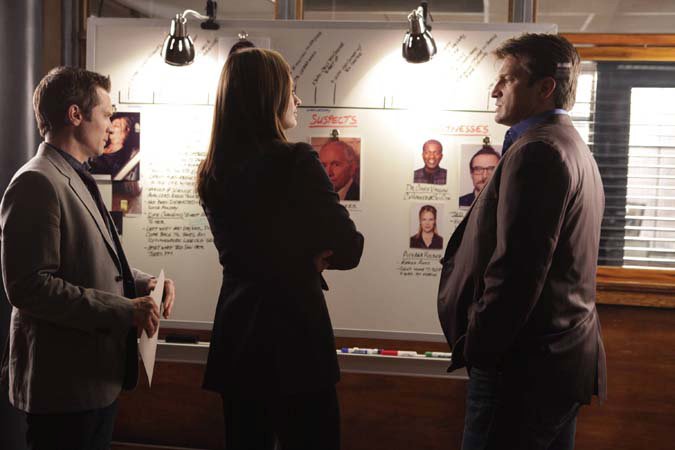
It is not your run-of-the-mill procedural.  There is a delectable smorgasbord of crime shows on TV these days. And while most have one or two elements that separate them from the pile, “Castle” goes even further.  The consultant as a type is nothing new.  “The Mentalist,” “Monk,” “Psych,” they all have super-observant, uncannily deductive leads helping to solve crimes.  There are even two current iterations of Sir Arthur Conan Doyle’s Sherlock Holmes (successfully) gracing our screens.  Richard Castle flows against this tide. He is neither manipulative nor overly perceptive. He is well-read and observant, yes, but he works the cases with his cohort, figuring out the mystery in concert, not racing ahead of these supposedly seasoned investigators. He tests theories and ideas out loud.  He thinks things through, backtracks when he is wrong, and talks to his partners. There are no fancy digital screens or Star Wars-esque holographic projections to piece together evidence. There is a white board, with photos and lists of evidence and details, handwritten.

that famous white board workingThere is no music video montage, à la “CSI,” to show the crime scene techs and medical examiners working diligently to unearth some hidden clue. There are long talks in front of said white board, heads brainstorming before hitting the pavement to investigate, à la Lenny Briscoe. No whiz kid computer geniuses forever clicking into database after database in some hyperlink labyrinth. There are manila folders and analog crime scene photos. The crimes are interesting and sometimes clever, avoiding the overly dark of “Criminal Minds” and the visceral, prurient themes in “Law & Order: SVU.”  There is, however, a lovely espresso machine for the squad room, purchased by Castle, because really, how much bad coffee can our champions be forced to swill?

Another thing going for this show?  A group of characters whose personal lives are an integral part of the story (not always so common among procedurals, nor so seamlessly integrated).  It’s easy to point out the presence of Castle’s mother and daughter, a little domestic drama to keep things balanced. We could discuss the womanizing habits of Esposito or the newlywed status of Ryan.

castle noir

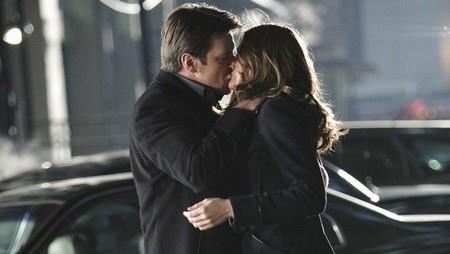
the kissBut what is its greatest accomplishment? (SPOILER ALERT!) The relationship between Castle and Beckett. Fraught with sexual and romantic tension (surely our heroes will come together!) throughout the first four seasons, there was a “Will they? Won’t they?” build in every scene together. And when it eventually happens, unlike “Moonlighting,” in which the finally united couple zapped the sizzle; unlike “Friends,” in which the on again/off again dynamic of Ross and Rachel just ended up boring this viewer, “Castle,” pulls it off gracefully and emotionally. When, at the end of Season 4, Beckett and Castle finally get in sync, you breathe a sigh of relief and let out a hearty “This is it! This is right!” It is the inevitability of Niles and Daphne, of Buttercup and Westley, of Marshall and Lily. The timing of it is like clockwork (not too long like “Friends”) and the tension, so palpable because of their chemistry, translates easily into tension navigating the workplace and their relationship with this new dynamic.  The writers and the actors have managed to keep that energy and pressure as they explore their first weekend away, hiding the relationship from their coworkers and the baggage of parents and past relationships.

The successes of the show are many. Its execution, its drama, its humor, all wrapped up in a package that includes a free solved crime every week, have made it a fan favorite.  More importantly, with its accomplished cast and talented writing, with its turn away from flash and music videos, , “Castle” has become the best procedural on television that is anything but.

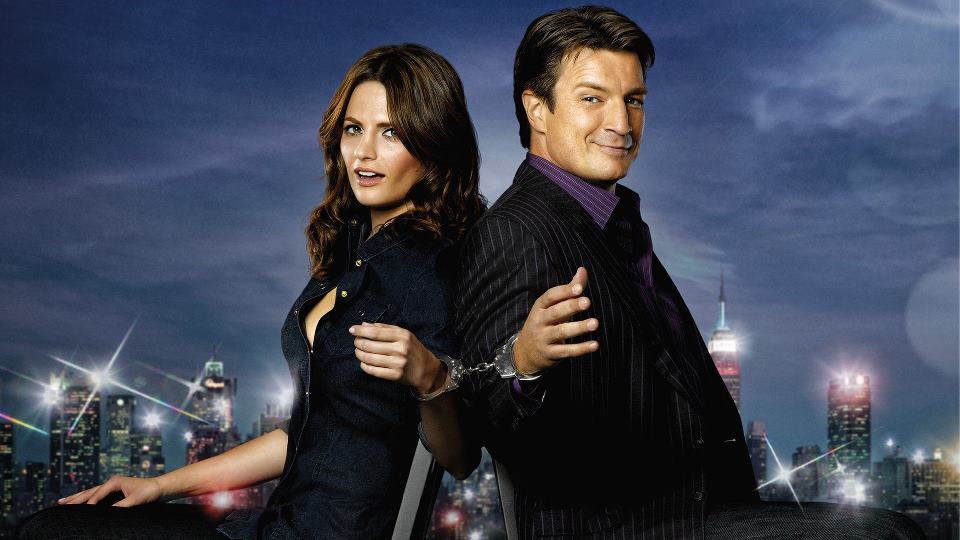
castle and beckett in trouble