What I Talk About When I Talk About Being Homesick

Le Mal du Pays

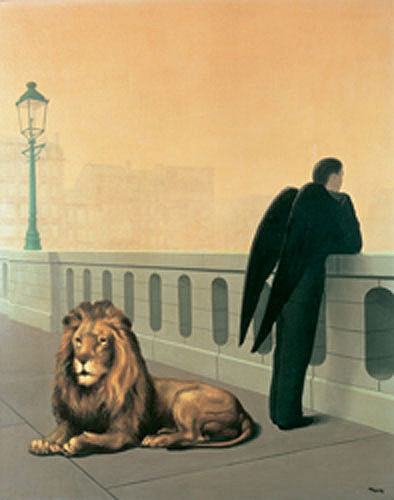
Magritte got it.
Magritte got it.

I.

It was the summer of 19— (and that’s enough to date me) and I’d been away, already, at university for a couple of years.  In those days, during breaks and weekends, I wasn’t going “home” to the mid-sized town in East Texas where I grew up; instead, I was going to Houston to stay with my maternal grandmother (qu’elle repose en paix).  I saw my family often enough. There were plenty of phone calls and the emails were starting to fly back and forth while I was still getting used to writing them.

Due to a bit of luck (or perhaps a bit of wisdom), both my parents were educators (now retired), and so at that point in my life, I had been fortunate enough to have visited somewhere between 25 and 30 states in this grand ol’ union of 50.  Always by car (those epic road trips, books and movies and games for endless entertainment), such travels were the highlights of our long, away-from-school, vacations.

Everything took a dramatic change in the aforementioned summer, an expected, though fully-embraced, topsy-turvy transformation.

I was smart (can we use precocious to describe a young man in his early 20s?) and had traveled more than most my age.  I’d read more than most my age, too. I’d left the country many times to visit the England of Sherlock Holmes, Candide’s Europe, even Gulliver’s Lilliput.  Yet, I’d never left the U.S., and I’d never traveled on a plane. I’d never even owned a passport.  In the summer of 19— (feel free to hum that Bryan Adams tune, but let’s be ABSOLUTELY CLEAR, it was not, I repeat, it was not the summer of  which he sings), I embarked on my first overseas journey, heading to Paris and other parts of France, as well as London.

At the airport, I was like a kid at a train station or, maybe, just like a kid at the airport.  I watched plane after plane take off and land; I watched them taxi to and from the gates.  Heck, I even watched my luggage conveyor into the bowels of the airport, and the glorified golf-cart-trains take said bags to the belly of the 747 beast.  Everything was shiny and interesting, exciting and awe-inspiring.  The nine-and-a-half hour flight would culminate in a completely new understanding of myself.

The descent into Paris started the following morning; I hadn’t slept a wink, it was just too cool to be on a plane, watching movies, eating free snacks and meals, drinking wine and champagne.  I can honestly say I really don’t remember whether, as we approached the city, I was able to see la Tour Eiffel from the window,

Tour-Eiffel-vue-du-ciel

or if the Byzantine poke of Sacré Coeur would have nudged us off course from Roissy-Charles de Gaulle.
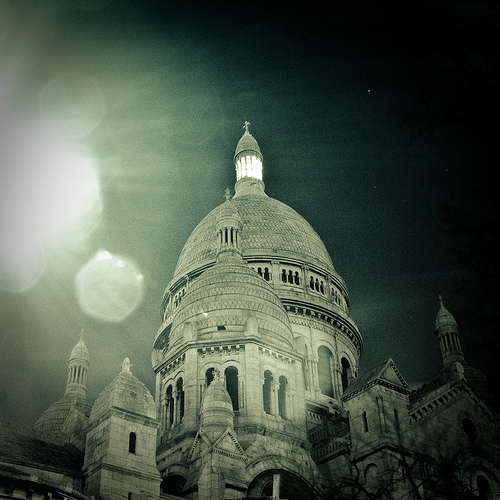
sacre coeur from below

landing at roissy

But I do remember landing. I remember the final drop in altitude towards the runway, clouds giving way to the cool gray of morning, then the industrial gray of buildings, and finally the slate gray of airstrip.   I remember, as we taxied, seeing for the first time French trucks and French buses, shuttling equipment and passengers from one adventure to the next.  I remember wondering what cool things the French pilots were saying to each other, and whether I would understand them in my still-basic French.  I remember the feeling of return, the feeling that I was home, unknown but welcoming.

But it wasn’t just a feeling. I was home, return of the son long lost from the arms of the Iron Lady, the fils manqué finally back to Marianne, enfant adopté de la patrie (to the tune of “La Marseillaise”), but part of the family all the same.  It was as if I were starting my own “Notebook of  a Return to the Native Land” though it would be another year or two before I would be drawn into Césaire’s text, a poem that still mesmerizes and confounds my understanding.  I found myself in the land of Voltaire, ready to be lost in the crowds of Baudelaire, wandering the street poems of Prévert.  I was eager to traverse the dreamscapes of Breton, stroll the rues and the boulevards under the sun and the moon, succumb to the embrace of the Left Bank and the Right.

Between the shades of gray, the jolt of ground and the screech of tire, I knew that I was chez moi.  After that arrival, plane cozied up to the gate, my torrid affair with Paris would leave the page and the pensée and be manifest in narrow streets and nightly walks, in park picnics and museum meditations. I would come to discover the self I had never known, but had always suspected.  And the US would henceforth be a place I was visiting, a temporary stop on return flights to La Ville Lumière.

à suivre

It’s got a funky beat, and I can really picket to it!

We all know about the ineffable quality of art—we can’t always explain why New Edition’s “Can You Stand the Rain” makes us feel better after a break-up, why CarlyRae Jepsen’s “Call Me Maybe” makes us want to film parody videos, or why we stand immersed, overwhelmed by Monet’s “Water Lilies.” But the artists, they know what they’re doing—Jean-Paul Rappeneau is fully aware that pulling the camera up and away, through the trees, as “Cyrano de Bergerac” dies, will leave us with a pit in our stomach; Mel Brooks recognizes that his “Blazing Saddles” campfire scene will leave you laughing no matter how often you see it.

Every creator, from the painter to the director to the composer, wants to evoke something. Through pop stars and film noir cinéastes and the Surrealists, art has the power to provoke joy, fear, anger. Even action.

Yes, protest music.  Everyone should have their favorite artist or genre, and few genres protest better than hip hop.  It has made the likes of Public Enemy and Paris icons for their peers. And in France, the engagement of hip hop has moved to a completely different level.  IAM, Kéry James, Assassin, Saïan Supa Crew, Disiz la Peste. They all have something to tell you.

Today’s translation comes from France’s Le Monde newspaper, a short blog post from about two weeks ago. The subject: an employee in a soon-to-be closed automobile plant not far from Paris. It just so happens that this assembly line worker is also an emcee in the group Tango & Kash, who have one album to their name.  The power of art can voice your anger, and in this case, hip hop is that voice, the way for the plant workers at Aulnay to speak in their own defense.

Please, read the translation of the blog, then watch the music video. Even if you don’t understand all the lyrics, the images are powerful in themselves. At the very end, for those who speak French, you’ll find a short documentary-style clip where the emcee Kash is interviewed, then gives us a little a cappella excerpt of the song.

Here is the link to the original post at Le Monde.

Please enjoy.

*****

“Of course there’s anger when they talk about restructuring,
Smoke screen as dangerous as exhaust gas.
False hopes reduced to nothing,
in the rhythm of their pretty, feel-guilty speeches.”

 Putting faces and words on the anger felt by 3000 employees at the Aulnay-sous-Bois plant run by PSA Peugeot Citroën. That was the object of Franck Jautee, stage name Kash. When he’s not running a team of six workers on the assembly line of the plant, Franck Jautee runs raps with his group, Tango and Kash.  On July 12, when PSA announced the closing of the plant at Aulnay, his colleagues asked him to write a song, so tells us the blog Aulnay Stories, of France Télévisions, which chronicles the daily struggle of the workers of the plant.  “I said, ‘Okay, I’ll make the music, but at the end of the summer, you all have to be in the video.” A few months later, on January 30, with the help of two other hip hop and video devotees, Sébastien and Régis, the clip was posted on the Internet. The buzz built quickly: in a few days, the video “ Ça peut plus durer ” was seen by close to 20,000 viewers.

“Verbal hold-up, a liar since the beginning,
our boss has more vices than the dealers in our streets.”

The rap mixes the crafted texts of Franck Jautee with news reports on the announced closing of the plant. You can hear in them the voice of David Pujadas, the newscaster of France 2’s evening broadcast. You can also hear one of his questions: “How far are you willing to go? — We’ll stop at nothing, go all the way to the end.”  The camera shifts between the assembly lines, showing workers at their jobs, and at their picket lines. “Sadness, anger, worry, sacrifice, depression, discontent, it can’t go on any longer…” The 35-year-old rapper has a good feel for a turn-of-phrase. Under his pen, PSA becomes “Politics in the Service of the Shareholder” [“Politiques au Service d’Actionnaires”] and “Bosses Sabotaging the Future” [“Patrons Saboteurs d’Avenir”].

Fifty-five employees let themselves be filmed for the needs of the video, according to Aulnay Stories. “I had to show who the people of PSA are, those who are going to find themselves either on the streets or part of some iffy layoff schemes, hidden behind smoke screens,” Franck Jautee explains to the journalists of France Télévisions, “They are the ones who will suffer all of that, they’re the ones who hurt.”  The musician, a worker on strike, envisions his video as a tool in the hands of the workers of Aulnay. On the Youtube page of the clip, a union rep from Créteil asks permission to download the video to share.  “Be my guest, enjoy yourself” Kash tells him.


Here is some documentary-style footage from Francine Raymond & Ludovic Fossard, authors of the blog Aulnay Stories :

*****