“Tingling like a first kiss, crazier than a death wish…” or just really ekphrastic!

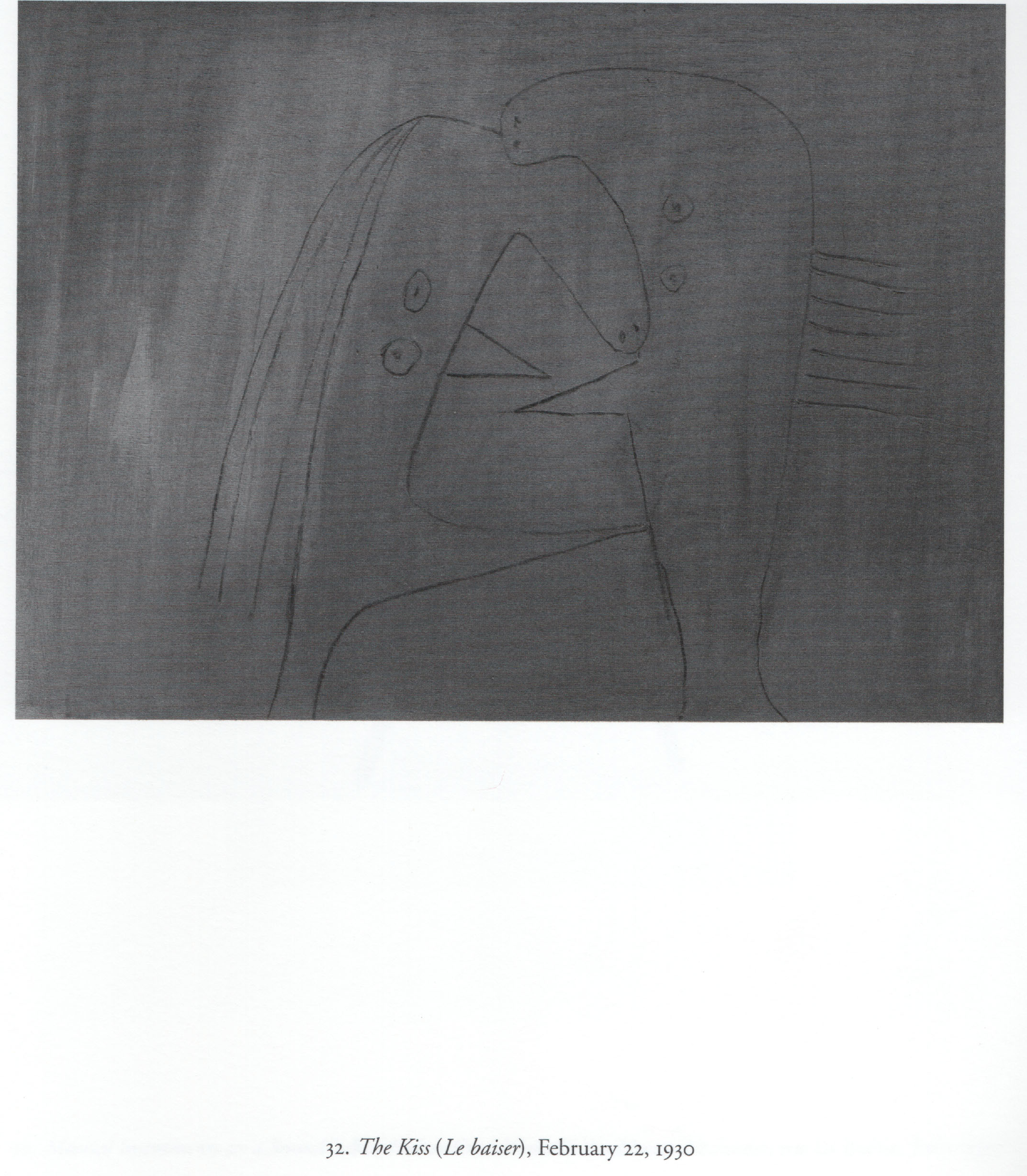
The Kiss

22 February 1930, charcoal & oil on wood panel

painted by Picasso, probably on a cupboard door

It is awkward, yes, but all the better

to practice

You must first, my dear,

lean your head towards me,

hair falling behind

you like waterfalling just before

    the great maw of tropical cave

your tongue, sharp, isosceles

    must invite

you sir, tilting head slightly back

    your upper lip above hers

    your tongue, too, arrowhead, trying to pierce her

keep your eyes open

it is awkward yes

do not touch tongues

    yet

open-mouthed—imagine devouring the other

        engulf breath and voice and time

do not touch tongues

    yet

open-eyed enter the other

mouth, consume and be consumed

    hold there

        first kiss, first loss

        I will sketch you

        it is awkward yes

        two forms always almost coming

            together

         awkward—to enter

            the other

                in voice & breath

                awkward

                forward

                you will not get this back

except perhaps when you open cupboard door.”

the kiss
With apologies for the size, it refused to get bigger.

The Parody’s the thing, wherein I’ll employ humor to make them sing!

Inspired by the image of a coffee mug floating around the social media googlenets, there is great hope (and exciting plans) to make a recording and eventual music video for this little ditty. With both great thanks and apologies to Sir Mix-a-Lot, I bring you

Baby Got Books

Oh my god, Becky, look at her book, it is so big.

She looks like one of those smart guys’ girlfriends.

But you know, who understands those smart guys?

They only talk to her because she looks like a total erudite, ‘kay?

I mean that book is just so big, I can’t believe it’s leather-bound,

it’s like collectable, I mean, gross. Look, she’s just so smart…

I like big books and I cannot lie

You other brothers can’t deny

When a girl walks in with an itty-bitty waist

And a bound thing in your face

You get dumb, then I pull up tough

‘Cause I noticed that book was stuffed

Deep with the knowledge I’m seekin’,

I’m hooked and I can’t stop readin’.

Oh baby, I wanna get wit cha, and see a lecture!

My colleagues tried to warn me,

but that book you got makes me so horny!

Ooo, soft- or hard-back, you say you wanna meet in the stacks?

Well choose me, peruse me, ’cause you ain’t that average groupie.

I’ve seen them readin’, to hell with Netflix streamin’

She’s smart, off-chart, got it going in HeadStart.

I’m tired of magazines sayin’ dumb girls are the thing

Take the average scholar and ask him that,

She’s gotta read the stacks!

So fellahs? Yeah! X2

Has your girlfriend got a book? Hell yeah!

Tell her to read it! Read it! X2

Baby got books — “Librarian face with half-price hard-back”

Baby got books! etc

I like ’em bound and thick, and when you read an epic

I just can’t help myself, I’m actin’ like an animal,

Now here’s my scandal:

I want get you home and huh

read out loud huh huh

I’m not talkin’ ’bout Playboy, ’cause literary novels bring the joy

I want ’em real thick and juicy

So read that juicy novel, Reads-a-lot’s in trouble

Beggin’ for a piece of that novel

So I’m lookin’ at youtube videos, lame-brained bimbos, empty heads like O’s

You can have them bimbos, my women will read Calvino.

A word to the thick book readers I wanna get wit cha

I won’t cuss or hit ya

but I gotta be straight when I say I wanna read

Til the break of dawn, this book’s got it going on.

A lot of simps won’t like this song

‘Cause them punks like to skim it and Cliff it

And I’d rather stay and read

‘Cause it’s long and I’m strong and I’m down to get my fiction on

So ladies yeah X2

You wanna read some Bukowski? Yeah!

then turn around, pull it out

Even dumb boys got to shout “BABY GOT BOOKS!”

Yeah, when it comes to females, Cosmo ain’t got nothin’ to do with my selection. Novels, plays, poetry? Haha, yeah, especially from the library.

Baby got books…

So your girlfriend holds a Samsung

Playin’ bootleg tracks from Hanson

But Hanson ain’t got a Kindle in the mix on their Samsung

My smart phone apps don’t want none unless you got books hun!

You can watch TV or Netflix, but please don’t lose those books

Some morons wanna play that hard role

And tell you that the book can go,

so they toss it, and leave it, and I pull up quick to reread it!

So the TV you got is flat, but I ain’t down with that

‘Cause the font is small and the plot gets thickened

And I’m thinkin’ bout readin;

To the eyecandy things flippin through magazines,

You ain’t it miss thing.

Gimme a scholar make me hollah,

Tolstoy and Shakespeare she found ballah!

Some knucklehead tried to diss ’cause his girls read my booklist

He had books but he chose to skim ’em, so I pull up quick to read with ’em

So ladies if the book is bound, and you want a literary throw-down

Dial 1-900-Reads-a-lot and kick them bookish thoughts

Baby got books

“Classics on the Kindle and she got much books” X3
When the Freeway of Love zooms to a dead end.

The Transporting Nature of Nostalgia

    I miss the days of being stuck at

stoplights

        that great white stripe, three, four lanes across

     from which we all get to go

        protected left on arrow, protected right on arrow

            red yellow green—safety in

                order, order in

                 chaos

Nowadays we’re all on the great concrete way

    fancy German sports sedans blazing

        on the right

past old American hand-me-downs

    poking and prodding along left lanes left

        for passing

& overpasses, overpassing the common volk & the homeless folk

        the strip mall windows and drive-through hopes

     overpasses over the traffic light democratics

    open lanes for overtaking and overbraking

    I miss the days of underground trains and

        on-the-ground buses, their keep-me-in-touch-

        with    humanity    hanging on to

this black strap, that cross bar

            offering my seat to the blue-haired lady

        or the hunched and forgotten vet, my

    reach to the heavens and hanging strap

                to over stand these passengers

    and this public transport transporting

        to overstanding

                        beyond the Big Budget Expressway, costly toll

            for the         mega-traffic, stock still

            as the         mega-steeple

            and the         mega-cross

            from the     mega-church

                mark time and distance to making it

home

        The Big Concrete Way: the Parking Lot of the Future

            always between exits, never getting to speed

    I miss the days of walking blocks, strolling hat-tips to

            friends, friendly hellos to vendors and

        vagrants and visitors and café-seated voyeurs

    I miss elbow bumps and excuse mes and

        lovely days and walk signals and don’t walk waits

            and pretty dresses and shiny leather shoes

                and setting my own pace and avoiding

        dog droppings and paper crumples and ice patches

            and even the occasional “you dropped this”

            or “no after you”

            or “could you tell me how to get to —”

At what cost the Freeway, with its perpetual deconstruction-construction

    orange cones lining narrow lanes and late-night delays

where speed limits jump and cruise controls shudder

    where parkways are

                from

                5AM to 9AM

                    &

                    3PM to 7PM

    moon day to fried day

            speed on down, speed on down the road

        past these people and these problems

            past these parties and this progress

        speed on down, speed on down the road

            Don’t you carry nothing that might be a load

                what with the exits not clearly marked and all

All poetry is political; some politics are poetical.

Reading the Ranting Rainbow

At the big pink building

in the big red state (the second biggest

until you take into account the

        heights of the hair

    widths of the buckles

            depths of the stupidity

        & lengths gone

                    by the gerrymandered godsquad)

sits-in the pink shirted army, crimson-faced

        because confronted with the blackest of hearts.

    Brown uniforms DPS the public lack of safety,

rose red running from foreheads & noses as

    they wade through the gray of maintaining order.

    Blue jeans & pink shoes run ragged

            the cautions of filibuster yellow.

& still the Red tide rolls, as if the T-party had

    the yellow moons on its side, the sun, orange stars.

        Pink hearts wishing on green clovers.

        Blue diamonds in the rough struggle, willing

    to throw purple horseshoes

            at the white milquetoast men.

“Stop!” they say, red light on their health care;

“Go!” they say, green light to bygone eras and errors,

    the green faces of those in pink, sickened

    by the s-curve in mountainous descent.

“Slow down!” they say, yellow-bellied response to

    the hot pink of progress, of parity, of

        personal choice.

At the big pink building

in the big red state

    pink shirts & crimson faces,

        dirtied by Brown uniforms & White Privilege

    fight to no avail

            against the blues of servitude

                the red of loss

                the gray of history’s clouded precedent

And hundreds of miles east

in the state sun yellowed & bleached blond

        black is still the shaded suspect

        white the night watch ranger

            red the blood on the sidewalk

                silver the bullet in chest

                    black the hoodie, black the gun

        and always, all ways

                the gray of uncertainty

                    blindfolded

        unseen, blinded Justice, whether under shined sun or lone star,

            mourns the loss of hues;

                gone the red of valor

                gone the white of innocence

                gone the blue of justice.

But Wait!

The new fall colors are in

                        GSR gray

                        Protest pink

                        Keltec 9MM black

                        Kevlar blue

                        Fascist brown

dress appropriately, you never know whose path you’ll cross.


Oh My! That’s So Ekphrastic!

Ekphrasis, in Greek, means “description.” I’m a big fan of ekphrastic poetry, that genre that, on the most basic level, is writing something descriptive about a visual representation (a painting, a photo, a sculpture). As the Poetry Foundation defines it, “An ekphrastic poem is a vivid description of a scene or, more commonly, a work of art. Through the imaginative act of narrating and reflecting on the ‘action’ of a painting or sculpture, the poet may amplify and expand its meaning.” The Academy of American Poets offers some fine-tuning that syncs nicely with my own work, saying “[M]odern ekphrastic poems have generally shrugged off antiquity’s obsession with elaborate description, and instead have tried to interpret, inhabit, confront, and speak to their subjects.”

Since my first encounters with the poetry of Ferlinghetti, and my first attempts with the flaming giraffes of Dalì, I have grown quite fond of art as inspiration. Thus is born the first poem inspired by the art of David Sweeney. His work, if you’ll forgive the brief, Cliff Notes-style, non-poetic ekphrasis, reminds me of the dream-like canvases of the Surrealists; his paintings make use of collage, of mixed media, which always summon my attention, reminiscent of the way I gravitate to some of the works of Picasso, Ernst or Braque. I am especially drawn to the appearance of text–newspaper clippings, stenciled quotes, scribbled phrases–in his art; the intersection of image and word begging for the poet’s ekphrasis. Lest I ramble on too much, I leave you to look at his œuvre at your leisure. If you find something you like, snatch it up, it’s hard to find good original art these days.

And now, to the poem.

It was first inspired by David Sweeney’s painting #517.

It can also be found at http://www.davidsweeneyart.com/works/b/david-sweeney,paintings, the second painting from the top.
It can also be found at here, the second painting from the top.

The italics (except for the French), including the title, are taken from some articles in the NYTimes regarding air travel. The thrust of the poem, in language and subject, has changed repeatedly, and the last line was a surprise, unexpected in its return to a minor detail in the painting, as I finished this, draft version 1.5.

Whatever Happened to First Class?

First, let’s get things straight. The euphemism for first caste has got to go, cleared for takeoff–always a misnomer misnaming for misdirection. Even before da Vinci’s device and the Wrights’ winged wonder, the ocean-gliding, wave-riding masted masterpieces kept the dividing line pretty clear, offering free passage to free labor for the not-so-free folks packed in the hold, barely holding on to their humanity, barely holding on to their little-scrap lunch.

So what happened to first caste? Classy became the label rather than the behavior, fancy china replacing fine company, fancy curtain replacing fine linen. And in first caste, room to stretch and kick, lie flat as capital’s whore, 300 channels to choose as you charge IMac and IPad and IPod and IPhone and IBeeper and ISnob, sip champagne, the warm wet sandpaper towel wiping from your face the grime of those in the back of the bus, the tail of the plane, the bottom of the boat. High above, the 1 percent fly first class; the .1 percent fly Netjets; the .01 percent fly their own planes.

Meanwhile, tail-side, knees to chest, elbows tucked with three-pretzel packs and chocolate-chip puck, the chosen few of the 99% lucky to escape the surface, grouped into herds by booking for boarding, one movie on one screen, one position for your one-inch seat, unsettle in for takeoff and turbulence.

And on the ground, far below, the (un)lucky 99%, stick in traffic, hostage to the toll road trolls, opt for one of the 300 $ burgers at the 300 fast food joints for the 300 lbs, the only bubbles from the soda machine–bottom caste transport never felt good.

“You go into first class because it’s less horrible than coach.” No cash to pay outright, CapitalOne card hassled to the max? Then it is perhaps with the free upgrade, high miles in your frequent flier club, without mile high club fornicating to give the bumpy flight some purpose. Which seat do you book? Which level are you?

Platinum Premium or Bronze Business, Elite Economy or Cushy Coach
Poached Ivory or Plated Silver, Gaudy Gold or Dazzling Diamond
these are the new
Fabulous First, Satisfying Second, Thirsty Third, Struggling Steerage which were
Captain and mates and crew and slaves from
King and Court and Lords and Serfs. Plus ça change, the more it stays the same.

And somewhere in the middle, betwixt the heaven and the hell, the poet, drifting in his dirigible, observes them all.

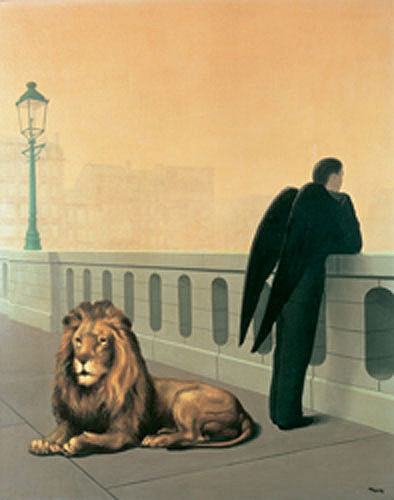
What I Talk About When I Talk About Being Homesick

Le Mal du Pays

Magritte got it.
Magritte got it.

I.

It was the summer of 19— (and that’s enough to date me) and I’d been away, already, at university for a couple of years.  In those days, during breaks and weekends, I wasn’t going “home” to the mid-sized town in East Texas where I grew up; instead, I was going to Houston to stay with my maternal grandmother (qu’elle repose en paix).  I saw my family often enough. There were plenty of phone calls and the emails were starting to fly back and forth while I was still getting used to writing them.

Due to a bit of luck (or perhaps a bit of wisdom), both my parents were educators (now retired), and so at that point in my life, I had been fortunate enough to have visited somewhere between 25 and 30 states in this grand ol’ union of 50.  Always by car (those epic road trips, books and movies and games for endless entertainment), such travels were the highlights of our long, away-from-school, vacations.

Everything took a dramatic change in the aforementioned summer, an expected, though fully-embraced, topsy-turvy transformation.

I was smart (can we use precocious to describe a young man in his early 20s?) and had traveled more than most my age.  I’d read more than most my age, too. I’d left the country many times to visit the England of Sherlock Holmes, Candide’s Europe, even Gulliver’s Lilliput.  Yet, I’d never left the U.S., and I’d never traveled on a plane. I’d never even owned a passport.  In the summer of 19— (feel free to hum that Bryan Adams tune, but let’s be ABSOLUTELY CLEAR, it was not, I repeat, it was not the summer of  which he sings), I embarked on my first overseas journey, heading to Paris and other parts of France, as well as London.

At the airport, I was like a kid at a train station or, maybe, just like a kid at the airport.  I watched plane after plane take off and land; I watched them taxi to and from the gates.  Heck, I even watched my luggage conveyor into the bowels of the airport, and the glorified golf-cart-trains take said bags to the belly of the 747 beast.  Everything was shiny and interesting, exciting and awe-inspiring.  The nine-and-a-half hour flight would culminate in a completely new understanding of myself.

The descent into Paris started the following morning; I hadn’t slept a wink, it was just too cool to be on a plane, watching movies, eating free snacks and meals, drinking wine and champagne.  I can honestly say I really don’t remember whether, as we approached the city, I was able to see la Tour Eiffel from the window,

Tour-Eiffel-vue-du-ciel

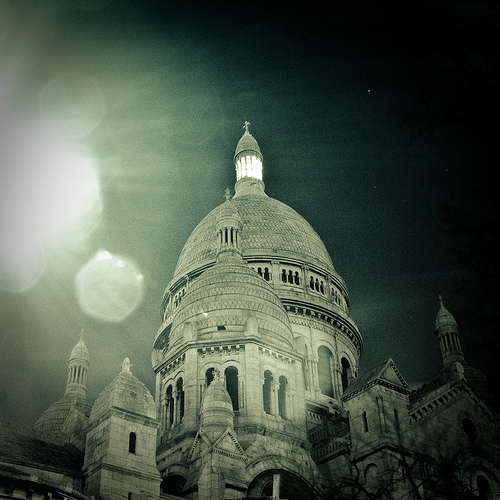
or if the Byzantine poke of Sacré Coeur would have nudged us off course from Roissy-Charles de Gaulle.

sacre coeur from below

landing at roissy

But I do remember landing. I remember the final drop in altitude towards the runway, clouds giving way to the cool gray of morning, then the industrial gray of buildings, and finally the slate gray of airstrip.   I remember, as we taxied, seeing for the first time French trucks and French buses, shuttling equipment and passengers from one adventure to the next.  I remember wondering what cool things the French pilots were saying to each other, and whether I would understand them in my still-basic French.  I remember the feeling of return, the feeling that I was home, unknown but welcoming.

But it wasn’t just a feeling. I was home, return of the son long lost from the arms of the Iron Lady, the fils manqué finally back to Marianne, enfant adopté de la patrie (to the tune of “La Marseillaise”), but part of the family all the same.  It was as if I were starting my own “Notebook of  a Return to the Native Land” though it would be another year or two before I would be drawn into Césaire’s text, a poem that still mesmerizes and confounds my understanding.  I found myself in the land of Voltaire, ready to be lost in the crowds of Baudelaire, wandering the street poems of Prévert.  I was eager to traverse the dreamscapes of Breton, stroll the rues and the boulevards under the sun and the moon, succumb to the embrace of the Left Bank and the Right.

Between the shades of gray, the jolt of ground and the screech of tire, I knew that I was chez moi.  After that arrival, plane cozied up to the gate, my torrid affair with Paris would leave the page and the pensée and be manifest in narrow streets and nightly walks, in park picnics and museum meditations. I would come to discover the self I had never known, but had always suspected.  And the US would henceforth be a place I was visiting, a temporary stop on return flights to La Ville Lumière.

à suivre

Goodbye NPM, see you next year! Oh, and

Remember This...

                I sat on the park bench and listened.
                I found it rather odd, actually-
                                there was one hen and two ducks,
                (and I know this isn't odd, but let me continue)
                and they were bickering
                                back
                                      and forth
                with three squawking geese.
                It was a fowl little debate,
                                with neither side
                                    appearing to give even
                                                an inch.
                I wasn't sure what the
                     squabble was
                                over
                but they were getting pretty rowdy
                                and beginning to attract attention.
                Suddenly,
                                four corpulent porpoises
                burst on the scene,
                                each with five pairs of Don Alberto tweezers.
                Apparently, they determined to pluck
                                the instigators.

                I've always hated violence
                                so I intervened.

                I thought humor was the key
                   and I happened to have
                                six limerick oysters with me,
                so I shouted to the fracas.
                For a moment they paused...
                                "Give me a minute to
                                                entertain and amuse.
                                 I'm sure you'll find it better than fighting," 
                                 I called.

                Now,
                        if you didn't know,
                        it's not wise to anger
                                fat dolphins 
                    (especially when they're already engaged).
                And with a clap of their
                        fins
                the entire area was crowded
                                with 7,000
                                Macedonians
                                in full
                                battle array.

At that moment
                                the birds flew away,
                and everything became quiet.
                     Apparently, they wanted to
                                   avoid
                                                confrontation as well.

                This left four porpoises and 7,000 Macedonians
                                a bit confused,
                                but they dispersed
                                with nary a thought.

                As this ended, I realized that
                                I had forgotten my companions.
                I turned back to the eight brass monkeys,
                                                who had just flown in
                                                from the ancient, sacred
                                                                crypts of Egypt,
                and asked them
                                their opinion on
                                the whole affair.

                They shrugged their shoulders
                                and stared at me
                                in confusion.

                I guess they were wondering where
                                                I got those oysters...

Let’s get poetical, political, I wanna get poetical, political, let me hear the body politic talk!

For Margo.

W. S. Merwin once said that all poetry is political; Jean-Paul Sartre called for a littérature engagée, engaged in the politics, absurdities, and struggles of the human condition.  From Whitman to Merwin, Prévert to Ferlinghetti, Ginsberg to Chuck D, Gil Scott-Heron to Reg E. Gaines, Baudelaire to Césaire, Guru to Solaar, poetry has long been engaged with some struggle. The best poetry (or any art for that matter) frames for us a way to deal with the difficult; sometimes poets find just the right words to express our outrage or shock.  They speak in our silence, and use silence to speak.  Some avoid rhyme in their efforts to reason, some eschew reason so that we may escape through their rhyme.

Muddled clichés aside, my own attempts to grapple with Boston (and Newtown and Aurora and Oak Creek and Kabul and Baghdad and a million other  cities and lives) are still in process; being thunderstruck at the inaction of leaders and politicians, my own wordlessness still thumbs through Webster’s and the OED, looking for just the right utterance to break the silence.   Others have already cleared their throats, already put pen to paper, already clackety-clacked on keyboards.

So it is with Margo Berdeshevsky, brilliant poet and brilliant photographer; an artist, whose voice sings true, of whom Sartre and Merwin would be proud.  She is also a dear friend and kindred spirit, a “soul mate” in these days of increasing soullessness in our topsy-turvied world.  I share with you a brief excerpt from her “Postcards to the Body Politic” and link you to the full poem, as well as to ma chère Margo giving voice to the weight.  When, in troubled times, the politicos and the press fail to speak truth, to state the obvious, to ask the difficult questions, it is to the poets we must turn, and at this moment, to Margo:

Postcards to the Body Politic

i

But there’s more. First, I cannot write dear. I cannot call you dear. I am too deeply, deeply  — and I have never believed in. Before. But now so much less. No. So much less. Dear illusion of dear. Dear I-could-not-write. You will not mind. You do not love.

Dear body. Dear if-my-right-hand. Dear how can you love only your own soul? Dear why would you feed only one eye? Not the hand. Not the belly. How can you love the head, not skin, not the water?

You make me cry. You make me sadder than women, sadder than men, even sadder than your —No. You, and your guns. Do you even love your hands? Can you love your mind? Body dangerous. I try to call you dear. Enraged at your arms, enraged at your desire, enraged at your eyes. If I am too angry to love you — what, what will we do?

To read the entire poem, simply click here. And the streaming audio of Margo’s words.

M. Jordan, where is my painting? — NPM

The following is an attempt at a sonnet in French (panic not! a translation, rough like sandpaper, follows). For those francophones who follow the blog, it is not really a sonnet in French, given the sketchy scansion and non-rhymes of some lines. So let’s call it a faux-sonnet, or a fauxnnet, shall we?


La Société Surréaliste
 
 
Les araignées et les citrouilles font la grève,
dans laquelle je vois des immeubles flambés,
allumés par les dalmatiens-pompiers.
Au jardin, un chameau lit un journal, fume, rêve

de l’avenir, de l’eau.  Il feint d’ignorer l’élève
qui essayait de nouer un plan.  Mais il s’est
noué dans ses idées.  Et le chameau, il sait
libérer cette peste—ils s'associent à la grève.

Les araignées, les citrouilles sont sérieuses
bien que le chameau et l’élève dansent et chantent
en écoutant la musique des manifestants.

Je me demande:  Comment on capte le merveilleux?
La télé montre cette spectacle obsolète
et n’importe où quelque dieu se gratte la tête.

The spiders and pumpkins are on strike,
in which I see burning buildings
lit by firefighter-dalmatians.
In the park, a camel is reading a newspaper, smoking, dreaming
 
of the future, of water.  He pretends to ignore the student
who is trying to come up with a plan. But he's caught
up in his own ideas.  And the camel, he knows
how to free this pain in the neck--they join the strike.
 
The spiders and pumpkins are serious
even though the camel and the student sing and dance
while listening to the music of the protestors.
 
I wonder:  How do you get the marvelous?
The TV captures this obsolete spectacle
and where ever you like, some god is scratching his head.

NPM–And afterwards, the villain wrote a villanelle!

Upon Discovering that the Only Thing in a Briefcase I Stole
Was a Bunch of Damn Poems
 
for robert phillips
 
What really pisses me off more than anything
(I mean, after the scraped and bloody hands)
is that some of these poems are rather interesting.

Most times I bring home CDs or something
I can sell easily, (like textbooks, nothing too grand).
What really pisses me off more than anything

is the absolute worthlessness of these stupid things,
no reward for a crime so perfectly planned,
though some of these poems are rather interesting.

It was late one afternoon, not a single
person walking in the lot, a literal no man’s land.
What really pisses me off more than anything

is not the broken glass tinkling
onto the ground, but the money I should have in my hand.
Though some of these poems are rather interesting

I can’t get a dime for their rambling,
(or the poet I’m sure), but damn
what really pisses me off more than anything
is that some of these poems are rather interesting.